

Content affiliation rarely makes it onto the agenda when brand decision-makers sit down to talk about AI visibility. It tends to live in the performance marketing corner, managed separately from SEO and content strategy, and it is almost never framed as a GEO lever. That is a missed opportunity, because when you look at how AI models actually construct their responses, publishers and specialized blogs turn out to be one of the most direct ways a brand can influence what gets said about it.
The Editorial Layer Dominates the Upper Funnel
When a user asks an AI model a question like "what are the best electric SUVs right now" or "which luxury fragrance should I buy as a gift," the model does not answer from memory alone. It retrieves and grounds its response on specific articles and pages it has access to at the moment of the query. Those sources are, in large part, editorial and publisher content: listicles, guides, roundups and comparisons published by media outlets.
In several brand categories we have analysed, editorial and publisher sources account for more than 40% of all the grounding citations that AI models use to generate responses. In some segments and for some query types, that share is even higher. The rest is distributed across brand-owned sites, retailers, communities and social platforms, but the editorial layer often carries the greatest single weight.
This matters for brands because editorial coverage is not just about traffic and awareness anymore. It is one of the primary inputs that shapes what AI models say. A brand that appears consistently and meaningfully across the high-authority articles that models use for grounding is a brand that benefits from repeated AI mentions, broader reference across sources, and the kind of cross-domain consensus that leads models to recommend it with confidence.
Understanding the Ecosystem First
Before activating any affiliate content strategy for GEO, brands need to understand the structure of their category's editorial ecosystem. Not all domains carry the same weight in AI grounding. Some outlets are cited hundreds of times across AI responses. Others, despite strong organic traffic, barely register.
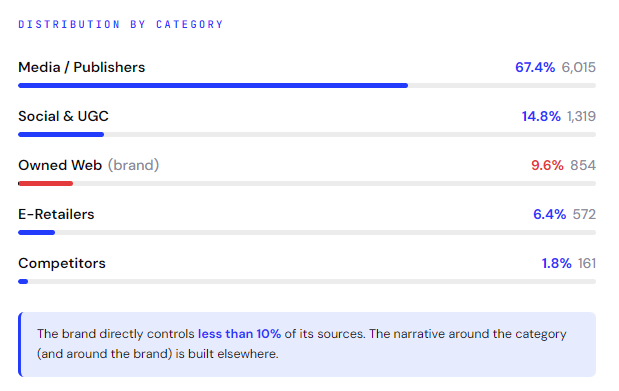
Small appliances client with 66%+ of grounding coming from media and publishers.
In the beauty and fragrance category, for example, the ecosystem is highly concentrated. A handful of publishing groups, including Condé Nast, Hearst, Future plc and Dotdash Meredith, account for the majority of all AI grounding citations. Within those groups, specific titles like Who What Wear, Marie Claire, Vogue and GQ generate a disproportionate share of AI-cited content. One single well-positioned article on the right domain can carry more AI grounding weight than dozens of placements on mid-tier sites.
There are also patterns worth understanding beyond just volume. Some domains grow in AI influence over time. Others decline. Niche-authority outlets can punch significantly above their traffic weight: a single URL from a highly specialised fragrance or automotive publication may generate more AI citations per article than ten pieces on a mainstream lifestyle site.
This kind of mapping is exactly what the GSP (Grounding Source Prominence) module in Prominence AI is built for. It helps brands to
Maps the AI grounding ecosystem within a specific category, showing which sources LLMs are actually using to build their responses.
Identifies the domains and URLs most frequently cited in AI answers, helping brands understand where real influence sits.
Tracks how source authority evolves over time, detecting which publishers are gaining or losing weight in AI grounding.
Reveals where the grounding weight is shifting, so teams can spot new opportunities before they become obvious in traditional SEO or media metrics.
Helps brands prioritize editorial placements based on AI relevance, not just traffic, domain authority or historical media value.
Turns GEO strategy into a data-led process, allowing brands to decide where to invest based on the sources that actually shape AI recommendations.
What the Data Tells Us About Correlation
In studies across brand categories, the relationship between editorial presence and AI visibility is not anecdotal. It is measurable and strong.
In an analysis of the automotive sector, for instance, the correlation between a brand's presence across the key AI-cited editorial domains in its category and its Share of Answer in AI responses is consistently above 0.85. In practical terms: brands that appear in more of the articles that AI models use for grounding tend to receive significantly more AI recommendations. Brands that are absent from that editorial layer, regardless of how good their owned content is, tend to underperform in AI visibility.
This does not mean editorial presence is the only variable. Brand authority, owned content quality and other signals all contribute. But for most brand categories, the editorial grounding layer explains the largest single share of AI visibility variance.
Listicles, Formats and the Spam Problem
The content format that dominates AI grounding citations in most categories is the curated list: "Best SUVs for families in 2026," "Top 10 luxury sedans," "The electric cars worth buying right now." These are the formats that affiliate content programmes have always produced well. They are also the formats that AI models cite most frequently.
However, this is precisely where brand and agency teams need to exercise judgment. The same demand signal that makes listicles valuable for GEO has also driven a significant increase in low-quality, AI-generated web spam in affiliate content. Publishers churning out thin, formulaic roundups at scale are not providing AI grounding value, and search engines are increasingly penalising them.
The lesson is not to avoid listicles. It is to be selective about publishers, to prioritise editorial outlets with real audiences and editorial standards, and to ensure that the brand's placement within an article is meaningful rather than a generic mention. A brand that appears as a thoughtful, contextualised recommendation in a high-quality roundup is in a very different position from one that is listed alongside thirty others in a piece that was clearly written by a machine.
Complement, Not Replace
Affiliate content for GEO works best as part of a broader strategy, not a standalone lever. The most effective approach combines it with two other lines of work.
The first is fine-tuning presence in articles that already perform. If an article is already being cited by AI models in your category and your brand is not in it, that is a near-term opportunity. Outreach to get included, or to update an existing mention into a more substantive one, can have immediate impact.
The second is owned content optimisation: ensuring that brand-side pages, product descriptions and editorial hubs are structured in ways that AI models can read and use for grounding. Affiliate and owned content should reinforce each other.
The brands that will build durable AI visibility are the ones that treat editorial presence as an ongoing discipline, not a campaign. Understanding which outlets matter in your category, tracking how that shifts, and activating affiliate programmes accordingly is the work. The AI visibility follows.