

Most of the conversations we are having with brands right now start in the same place. They want to know how to show up in AI-generated answers. And almost immediately, the discussion turns to content. What to produce, how to structure it, how to optimize it for LLMs. The assumption underneath is familiar: if we build it well enough, the visibility will follow. It is the same instinct that drove SEO investment for two decades. And it is only partially right.
Where budgets are going is not always where the leverage is
The default response to AI search optimization, across many of the brands and teams we work with, has been to allocate more toward owned content production. More articles, more structured data, more on-site optimization. It makes sense on the surface. It follows established logic. And it is not wrong, exactly. But it is incomplete in a way that is starting to matter.
Brands winning in AI-generated answers are not necessarily the ones publishing the most. They are the ones with the widest, most consistent presence across the third-party domains that models actually rely on to construct responses. That is a different problem. And it requires a different kind of investment.
We measured it. The correlation is hard to argue with.
For a client operating in a competitive category, we ran a structured analysis using GSP, Grounding Source Prominence, one of the core capabilities in Prominence AI. The methodology maps the URLs and domains that large language models use as grounding sources, tracks brand mentions at page level across those domains, and builds a detailed picture of who appears where and how consistently.
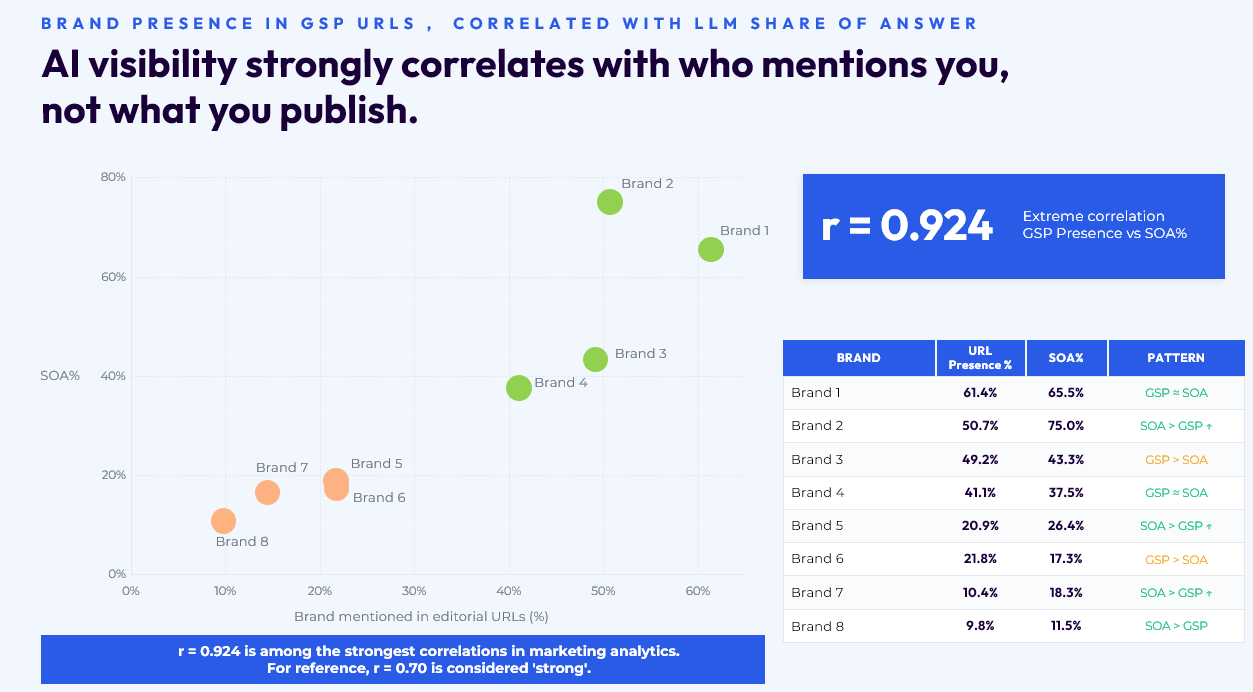
We then correlated that publisher-level presence with Share of Answer: how frequently each brand appears in AI-generated responses across the category. The result was r = 0.924.
gsp-correlation1
In marketing analytics, r = 0.70 is considered strong. What we found is in a different league. The relationship between third-party presence and AI visibility is not a loose directional signal. It is one of the most statistically robust patterns we have seen in this space.
The brands dominating AI answers are not the most prolific publishers. They are the ones with the deepest, most consistent footprint across the editorial sources that shape how models understand a category.
Some brands are the default answer. Most are not. The gap is structural.
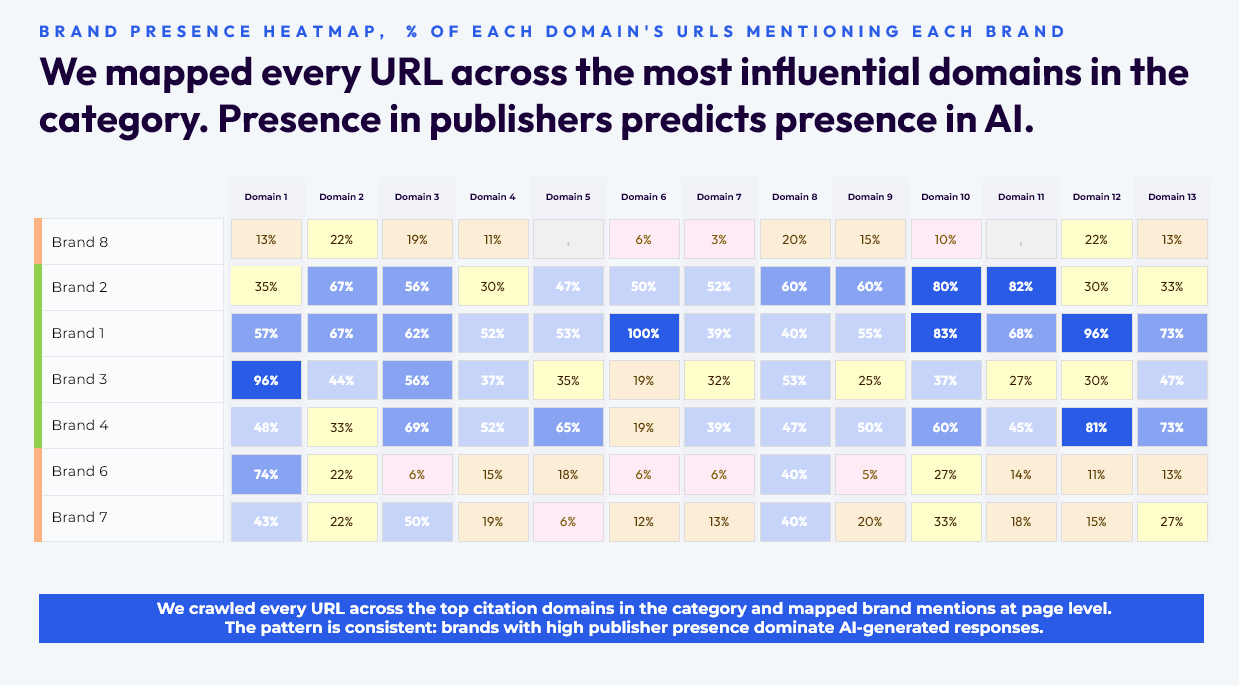
When you map brand presence across the top citation domains in a category, the picture becomes concrete very quickly.
Certain brands appear consistently across nearly every influential publisher in the set. Others spike in one or two domains and drop off completely. Some are barely visible anywhere. This is not a content quality problem. It is a footprint problem, a distribution and relationship problem built up, or not built up, over time.
The brands functioning as default answers in AI responses share one characteristic: sustained presence across a stable set of editorially influential sources. Not necessarily the biggest publications. The ones that happen to define how models interpret a category. That distinction matters, and it varies significantly depending on the vertical, the market, and the stage of the journey you are looking at.
geo-correlation2
What drives AI visibility in beauty is structurally different from what drives it in financial services. What matters at consideration is not what matters closer to purchase. This is something we observe consistently, and it is exactly why static assumptions are so dangerous here. The map of sources that matter has to be understood per category, not assumed.
This is forcing a real change in how teams need to work together
Here is where the conversation gets uncomfortable for some organizations.
The kind of presence that drives AI visibility is not owned by any single team. It lives at the intersection of PR, SEO, paid media, content, advocacy, and digital partnerships. And in most companies, those functions are still operating with separate briefs, separate metrics, and separate budget lines.
We worked with a client who used this analysis to restructure their approach. They moved away from broad placement volume and toward a tighter set of high-impact publishers. They identified content formats overrepresented in model grounding for their category and shifted distribution accordingly. They strengthened editorial relationships with specific groups. They activated content partnerships and advocacy mechanisms aligned with the domains that actually shape AI responses in their space.
None of that was a content production decision. It was a strategic positioning decision that touched PR, SEO, and partnerships simultaneously. The teams had to be in the same room, working from the same data.
That integration is not optional anymore. The brands that figure it out early are building a structural advantage that compounds over time. The ones that do not are optimizing in the wrong direction, spending on owned content while the visibility gap widens outside their walls.
Start by changing the mental model, then the process
Before optimizing anything, the shift has to happen in how teams think about AI visibility. Here is where to start:
Analyze your category as AI sees it. Run responses at scale across the queries that define your space. Understand which brands are the default answer, and why. This is the baseline everything else builds on. Map the ecosystem behind those answers. Identify which domains and publishers are shaping model responses in your category. Not the biggest names in general, the ones that matter specifically here, in this market, at this stage of the journey.
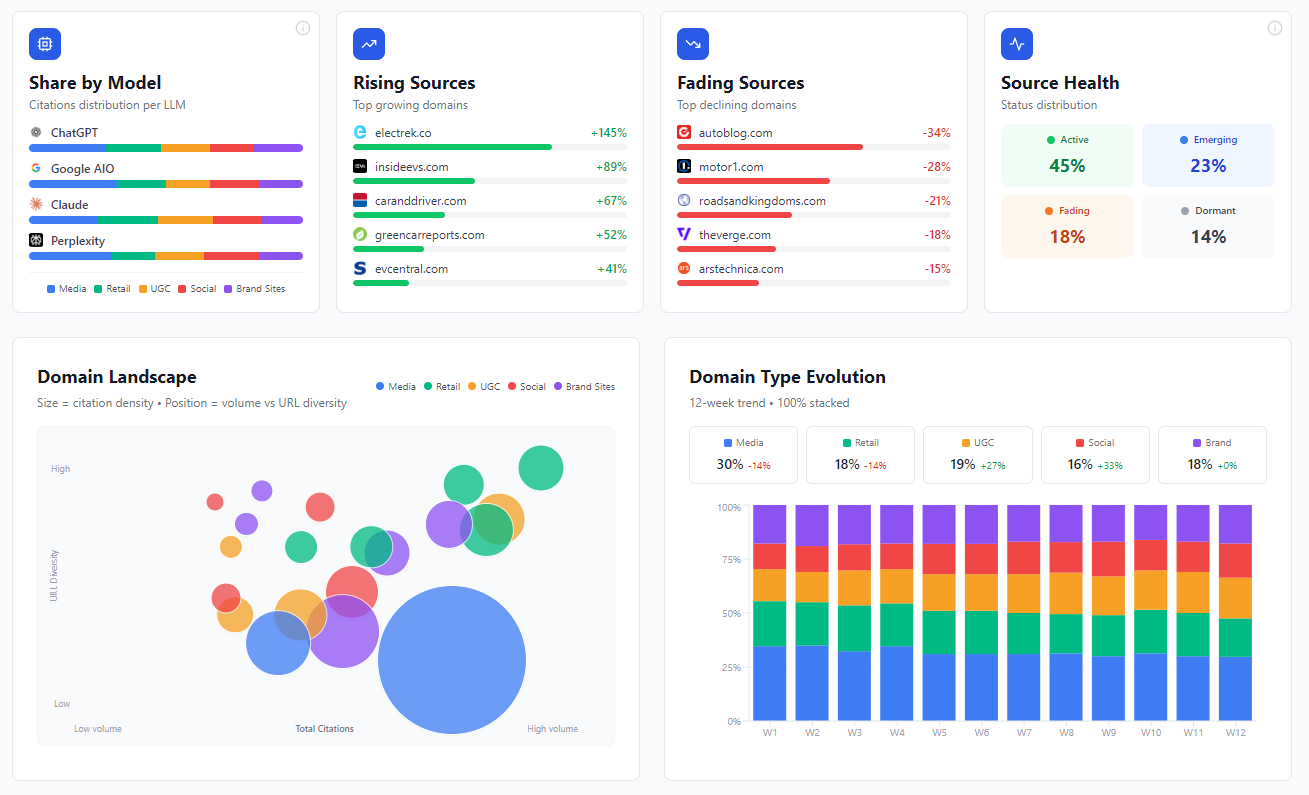
Prominence AI helps you to understand who is shaping the answers in your category
Align your stakeholders around a shared picture. PR, SEO, content, paid, partnerships. Show them the same data. The footprint problem cannot be solved by one team working alone. It needs a shared brief and shared accountability.
Define priorities by format and environment. Some content types are consistently overrepresented in model grounding. Some are not. Knowing which formats drive presence in your specific category is what turns the heatmap into an action plan.
Close the gaps through the right channels. Top editorial voices, content partnerships, affiliate relationships, advocacy programs. Prioritize the domains where your brand is underrepresented relative to competitors and where influence on AI outputs is highest.
Build it as an ongoing capability, not a one-off audit. The ecosystem shifts. Models update. New sources enter the picture. The brands that stay ahead treat this as continuous measurement, not a quarterly report.
Owned media is still essential. But the center of gravity has moved.
Brand websites remain critical assets. They provide depth, consistency, and a source of truth that no third-party coverage fully replaces. Owned content still matters. The recommendation is not to abandon it.
But in the context of how AI answers are actually constructed, the primary driver of visibility is what happens outside those properties. Across a set of sources you do not control, but absolutely can influence through PR relationships, editorial presence, content distribution, advocacy, and strategic partnerships.
Search has always rewarded brands that understood the world beyond their own website. AI makes that logic more measurable, more explicit, and considerably more urgent.
The digital footprint was always important. Now it is something you can map, quantify, and act on with precision. That changes the conversation about where to focus, where to invest, and how to measure progress.