

The journey we knew is falling apart. For two decades, the consumer search journey followed a predictable pattern where the user type a query, scan a list of results, click on a few, compare, decide. Brands competed for position. Whoever ranked higher, won. But that model is breaking down.
When someone asks ChatGPT, Gemini, Perplexity or Claude which product to buy, which vendor to hire, or which solution to implement, they do not get a list of ten blue links. They get one answer. A narrative built by the AI that synthesizes multiple sources, compares options and, in many cases, makes a direct recommendation. The user does not need to click anything to make a decision.
This is already happening. According to McKinsey, half of consumers already use AI-powered search, and this channel is expected to impact $750 billion in revenue by 2028. Gartner projects that AI assistants and LLMs will handle roughly 25% of global search queries by 2026.
And here is the number that should worry any marketing leade. SparkToro's zero-click study found that over 60% of Google searches already end without the user clicking on any result. The interaction dies on the SERP itself. And this data came out before the generative AI boom. The reality most brands have not prepared for was already here. Now, with LLMs providing full conversational answers, zero-click is not a trend. It is the default behavior, accelerating faster than most marketing teams can adapt.
Traffic still matters, but its nature has changed. Users who reach your website after consulting an AI arrive with a much more formed decision. Evidence suggests that AI-referred traffic converts at significantly higher rates than traditional organic traffic. Fewer visits, but with far more intent.
The question is no longer how many visits you get. It is whether you exist in the answer the AI constructs before the user even considers visiting you.
What is the AI Search Journey
The AI Search Journey is the path a user follows when they use a language model as their starting point for making decisions. It is not an adaptation of the classic funnel. It is a different model: shorter, more concentrated, and it unfolds almost entirely outside the brand's own digital assets.
Phase 1: Prompt
The user does not type a keyword. They ask a question in natural language, with context, with defined intent. "What is the best CRM for a B2B company with fewer than 50 employees?" is not the same as typing "B2B CRM" into Google. The intent arrives far more qualified from the very first interaction.
Phase 2: Synthesis
This is where everything shifts. The LLM does not return a list of options for the user to research. It builds a single narrative that synthesizes information from multiple sources. And in that narrative, your brand either appears or it does not.
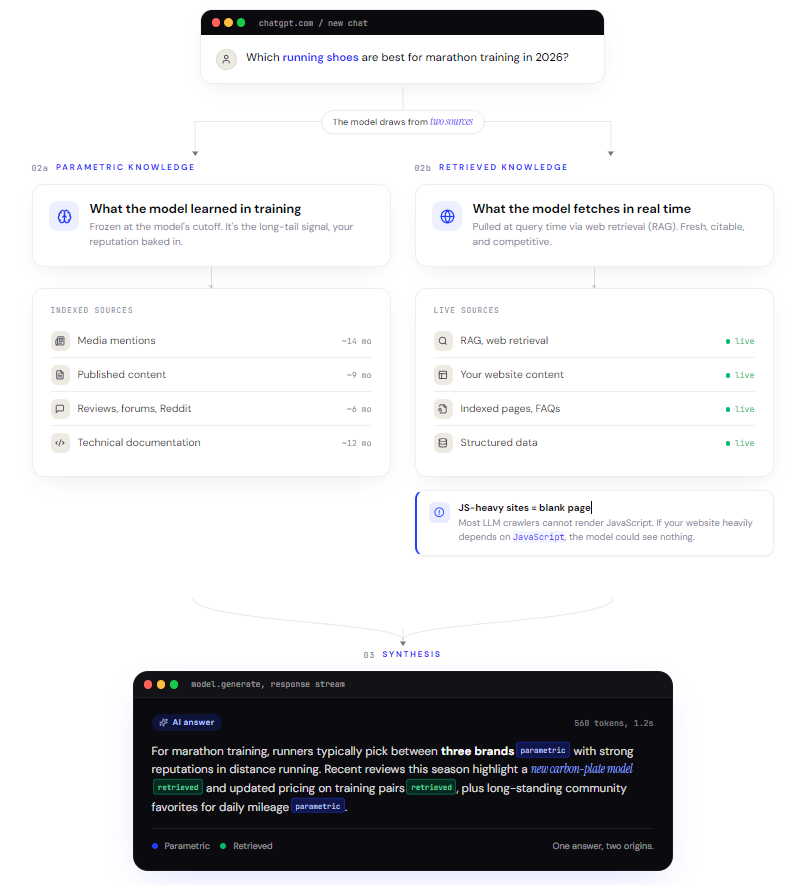
To understand why a brand is visible or invisible at this stage, you need to understand how an LLM's knowledge actually works. There are two fundamental sources:
Parametric knowledge. This is what the model "knows" because it learned it during training. It is based on the accumulated digital footprint of the brand: mentions in media, published content, presence in forums, reviews, technical documentation, academic articles. Everything that existed in the data the model was trained on. If your brand has a solid and consistent presence across authoritative sources, the LLM probably has it embedded in its base knowledge. If not, it simply does not know you exist.
Retrieved knowledge. This is what the model searches for in real time to complement its response. When systems like Perplexity, Google's AI Overviews, or ChatGPT with browsing answer a query, they do not rely solely on what they already know. They fetch updated information, process it and weave it into their answer. This is known as RAG (Retrieval-Augmented Generation).
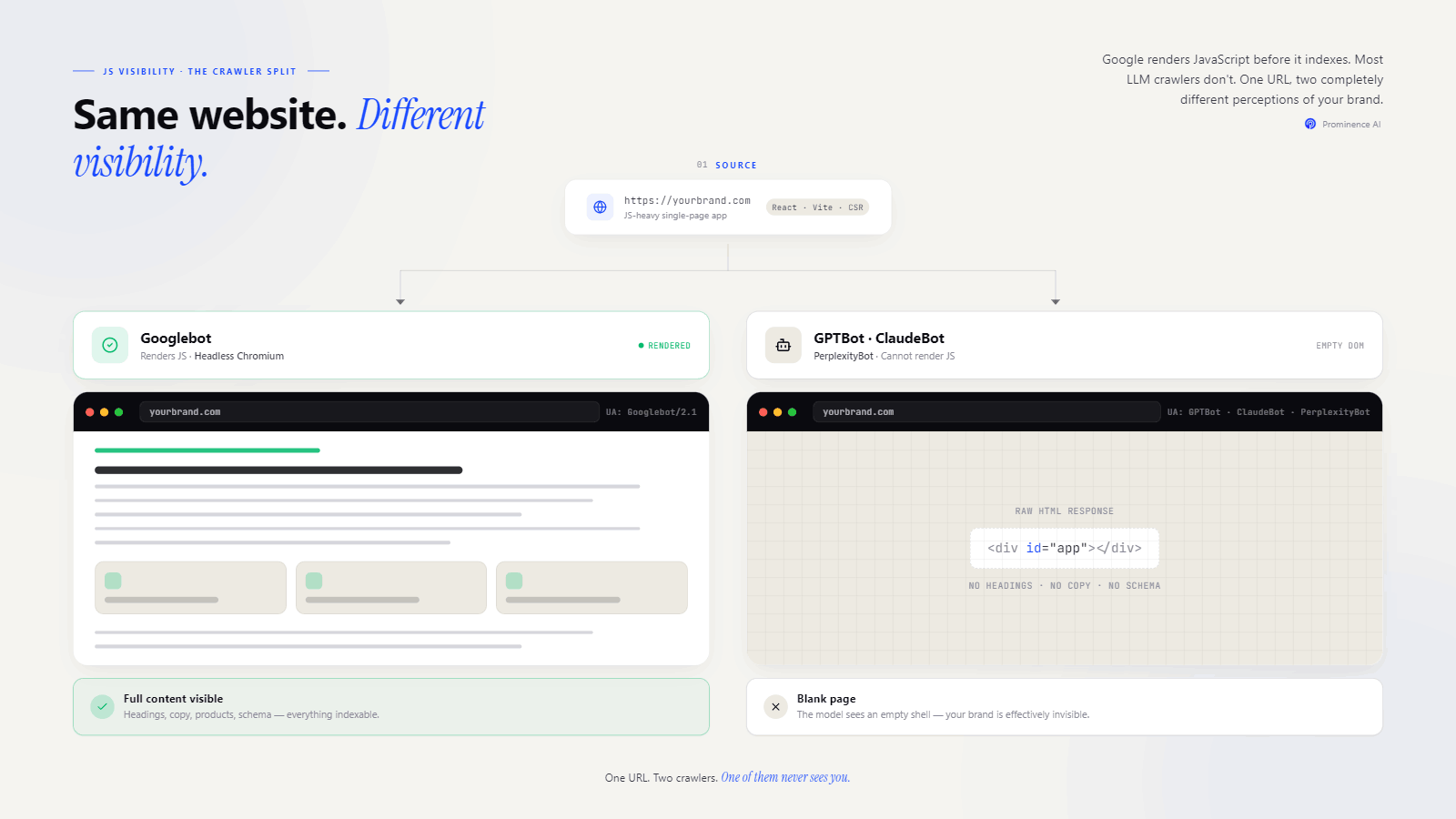
And this is where a problem surfaces that almost nobody is addressing: the JavaScript trap.
JS-Visibility-Split
Many brands have invested heavily in digital platforms built with modern JavaScript frameworks: React, Angular, Vue, single-page applications. Google has spent years investing massive resources in rendering JavaScript, so these websites get indexed reasonably well in its search engine. But LLM crawlers are not Google. Most bots used by language models do not render JavaScript. When they try to access a JS-heavy website, what they find is, literally, a blank page.
This means that all the content a brand has created (case studies, product documentation, technical articles, comparison pages) can be completely inaccessible to the AI if the technical architecture does not allow it. The technical foundations we have taken for granted during the classic SEO era need urgent revision. What worked for Google does not necessarily work for LLMs.
Brands need to work on both fronts: building parametric knowledge over time through presence in authoritative sources, and ensuring their retrieved knowledge is accessible by fixing the technical architecture of their digital assets.
Phase 3: Evaluation
In the classic journey, evaluation happened on each brand's website: the user visited three or four sites, compared pricing, read reviews, studied features. In the AI Search Journey, evaluation happens inside the conversation with the AI.
The user asks follow-ups: "What is the difference between option A and option B?", "Which one is better for my specific case?", "What do users say about option C?". The LLM acts as a personalized advisor, not as a search engine. And the brand has zero control over how it is presented in that conversation. It cannot edit the response, adjust the message, or show its carefully optimized landing page.
The loss of experience control is one of the deepest changes in this new paradigm. For years, brands have invested in designing flawless customer journeys within their own assets: conversion funnels, landing pages, nurturing sequences. In the AI Search Journey, that control vanishes. The LLM decides what to say about you, how to compare you against competitors, and which aspects to highlight or ignore.
Phase 4: Action
The user acts: visits the website, requests a demo, makes a purchase, contacts the sales team. But they arrive with a decision that is practically made. The consideration cycle has compressed from days or weeks into minutes of conversation with an AI.
This has a direct strategic implication, because every visit you receive is worth more than before. If the user reaches your website after the AI has already qualified them, the conversion rate should be significantly higher. But only users whose brands were mentioned by the AI will ever arrive.
AI Search Journey steps
The journey gets shorter, moves off your turf, and slips out of your hands
It is worth pausing to understand the three structural shifts that the AI Search Journey introduces:
It gets shorter. What used to require multiple search sessions, visits to several websites, reading reviews and manual comparison now happens in a single conversation. Touchpoints shrink dramatically. The path from intent to action compresses.
It moves off your turf. 72% of AI-assisted purchase journeys never touch a brand's owned channels. The journey no longer takes place on your website, your blog or your landing page. It takes place in ChatGPT, in Perplexity, or in Google SERPs. The brand loses the ability to guide the user through its own digital ecosystem. The intermediary is the AI.
It slips out of your hands. You cannot control what the AI says about you. You cannot edit the response. You cannot insert your value proposition with the exact words you have chosen. The narrative is built by the model, based on its parametric knowledge and the sources it manages to retrieve. If those sources are inaccurate, incomplete or directly inaccessible (as in the case of JS-dependent websites), the image the AI projects of your brand can be distorted or, worse, nonexistent.
Zero-click reaches a new level
The concept of "zero-click" is not new. We have been talking about searches that end without a click for years. But in the AI Search Journey era, zero-click reaches a completely different level.
In traditional search, a zero-click search meant the user found the answer in a featured snippet or in the SERP itself. The brand at least appeared as a visible source. In the AI Search Journey, zero-click means the user receives a complete, personalized, conversational answer without any brand getting the chance to show its website, its design, its user experience. The decision is made inside the AI.
As Fishkin argues, traffic as a goal is increasingly problematic. Every source of referral traffic is declining. And what he proposes echoes directly in the AI Search Journey: what matters is not how many visits you generate, but whether your brand has presence and credibility in the spaces where your audience actually makes decisions. And today, one of the primary spaces is the conversation with an AI.
This does not mean traffic is irrelevant. It means we need to rethink what we measure and why. Product and conversion metrics (landing page visits, demos requested, sales) remain valid. But we need to complement them with metrics that capture something that did not exist before: our presence in AI-generated answers.
New metrics for a new journey
If the journey has changed, metrics must change too. You cannot optimize what you do not measure, and traditional web analytics tools are not built to capture what happens inside a conversation with an LLM.
At Prominence AI we work with multiple KPIs, but those are our two core metrics:
Share of Answer. This measures the percentage of AI-generated responses in which your brand is present. It is not a ranking. It is a frequency. In the world of LLMs there is no fixed "position #1." Models are non-deterministic, and the same question can produce different responses each time. What matters is how often your brand shows up across those responses. A high Share of Answer means the AI consistently considers you relevant.
Citations. This measures when your website is directly consulted by the model to build its response. It is the closest equivalent to a "click" in the AI Search world: the AI has accessed your content and used it as a source. Citation is a strong signal that your content is accessible, relevant and carries enough authority to be retrieved by RAG systems.
These are just two of the metrics we work with. If you want to go deeper into the full measurement framework for GEO, read our dedicated article: KPIs for GEO: Redefining How We Measure Visibility in the Age of Generative Search
What brands can do today
GEO (Generative Engine Optimization) builds on solid SEO fundamentals, but with new priorities. It is not about abandoning what works. It is about extending it toward a new discovery channel.
The most urgent actions we recommend:
Audit your technical foundations. Check whether LLM crawlers can actually access your content. If your website relies heavily on client-side JavaScript, a large portion of your content is likely invisible to the AI. This technical audit is the mandatory starting point. Without it, any GEO content strategy is built on broken ground.
Build parametric knowledge. Work on your presence in sources that LLMs use during training: specialized media, authoritative publications, technical documentation, relevant forums like Reddit, review platforms. This is not classic link building. It is about constructing a digital footprint that the AI can absorb.
Optimize for retrieved knowledge. Make sure your content is structured so RAG systems can easily retrieve it: clear answers to frequent questions, concrete data, well-organized comparisons, content the AI can cite directly.
Measure what did not exist before. Implement tools that monitor your presence in AI-generated answers. You cannot optimize what you do not measure, and traditional web analytics tools do not capture this new journey.
The journey has changed. The question is whether your brand knows it.
The AI Search Journey is not a prediction. It is how millions of people are making decisions right now. Every day a brand does not monitor its presence in AI responses is a day its competitors might be getting recommended instead.
96% of the B2B companies we have analyzed are invisible to AI. That means 96% of companies whose content, value proposition and differentiation simply do not exist in the journey their potential customers are taking at this very moment.
The good news is that this is new territory for everyone. Brands that move now will have a significant head start over those that wait for the market to catch up. But of course, that window will not stay open forever.