
For the last twenty years, SEO has been built on a familiar measurement system. Clicks, impressions, rankings, organic sessions and traffic share. These KPIs shaped how brands understood performance, how they allocated budgets and how they justified decisions. But search is moving into a new era. An era where the click is no longer the centre of gravity. An era where Generative Search reshapes how users discover, compare and choose.
In this environment, brands need new frameworks. Not because the old metrics were wrong, but because the rules of the channel have changed. Generative Engine Optimization requires a different way of understanding visibility, influence and presence. And the shift has already begun.
GEO KPIs
From a world of clicks to a world of answers
Even before LLMs entered the picture, Zero Click Search was rising sharply. Several studies estimate that more than sixty percent of searches on traditional engines result in no click. Users get their answer directly inside the interface. The arrival of AI Overviews, conversational search and single answer interfaces accelerates this trend. The focus is no longer on who gets the click. It is on who shapes the answer.
This is the starting point of GEO measurement. The click becomes a secondary outcome, not the primary goal. Visibility happens upstream, in the model’s reasoning steps, the citations it uses and the sources it trusts. If a brand influences that process, it influences the user’s decision journey. Even without a direct session hitting the website.
Accepting this shift is healthy. Other channels have been operating on non click metrics for years. Video uses completion and view time. Paid social uses engagement and assisted outcomes. Display uses impression quality and incremental lift. GEO simply requires the same mindset. Measure what truly reflects influence, not only what produces traffic.
Introducing new GEO metrics: visibility beyond traffic
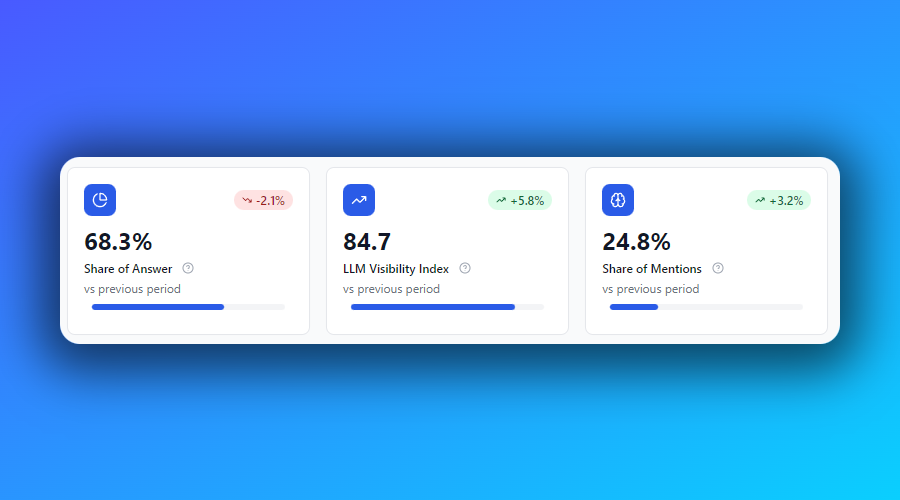
This new channel needs new KPIs. At Prominence AI, we approach measurement through a set of indicators that capture how often a brand appears in generated answers, how prominently it is mentioned and how the model evaluates user sentiment around it. These metrics are introduced gradually and naturally as part of a broader framework, because they are meant to solve a real need.
One of the core metrics is Share of Answer, which tells us how often a brand is delivered as the primary response within a given prompt dataset. It plays a role similar to rankings in classic SEO, but translated into a world where there are no ten blue links, only a single generated answer.
Another key dimension is Share of Mentions, born from the idea that influence goes far beyond owning the top slot. A brand may not be the definitive answer, yet it might repeatedly appear in the model’s reasoning or in secondary suggestions offered to the user. This is often the real moment of consideration, and this metric captures that space.
To complete the view, we use Average Position. This metric looks at how prominently a brand appears within the responses where it is mentioned. Instead of measuring presence alone, it measures position. Every time the model references a brand, we score that mention based on where it appears in the list or reasoning. It’s a clean, position-based way to understand how strongly a brand shows up when it’s part of the answer.
Finally, AI Sentiment becomes a central piece in Generative Search. If models internalise the full universe of public reviews, opinions and conversations, brands need to understand how they are being framed. This is where AI Brand Sentiment matters. It reflects how models interpret and relay the overall tone around a brand when interacting with users.
Why a new framework is necessary
This is more than a change of metrics. It is a change of mindset.
There is a growing uncertainty among brands. Teams are trying to define what this channel is and how it should be measured. There is no established industry standard yet. Each model works differently. Each interface behaves differently. Each dataset produces different outcomes. And the pace of change is fast.
Still, ignoring Generative Search is no longer an option. Its influence on user decisions is already significant. It guides product discovery. It shapes brand comparisons. It informs recommendations. And it does so at moments where users are evaluating alternatives and making purchase choices.
For these reasons, GEO should be treated as a standalone channel within the marketing mix. It requires dedicated analysis, structured reporting and integration with broader brand measurement. The scale and impact justify it.
A comparison with traditional SEO measurement
SEO evolved around metrics that could be tracked easily. Rankings, organic sessions, impressions, CTR, conversions. But these metrics depended on a browser based journey that remains visible. Generative Search reduces that visibility. The decision happens inside the model, not on the website.
Concept | SEO | GEO |
|---|---|---|
Primary KPI | Clicks, Sessions, Revenue | Share of Answer (SoA) |
Secondary KPI | Rankings, CTR, Impressions | Share of Mentions (SoM), Average Position, AI Sentiment |
What is being measured | Traffic generated | Presence and influence inside model responses |
Channel scope | One primary engine | Multi model landscape |
Success definition | Visits and conversions | Influence on recommendations and brand framing |
This does not mean SEO becomes irrelevant. It means SEO becomes one part of a larger ecosystem. Content still influences grounding. Websites still act as the corpus the models learn from. But the point of measurement shifts earlier in the journey. Instead of asking how many users reached the website, the question becomes how often the brand reached the answer.
This evolution is natural. It mirrors the trajectory of search itself. As interfaces move from lists to answers, measurement must move accordingly.
Building a GEO measurement framework
A robust GEO measurement framework should include several layers.
The first is visibility, captured through metrics like Share of Answer and Share of Mentions. These reflect presence and influence.
The second is breadth, measured across models, prompt categories and user segments. Each model behaves differently, so distribution matters.
The third is sentiment and context, which define how positively or negatively a brand is positioned in the generated narrative.
The fourth is influence on the broader ecosystem. If grounding sources highlight specific domains, PR and content teams can act on them and expand the brand’s presence.
Finally, everything should integrate with traditional SEO and brand metrics. GEO does not replace them. It completes them.
Looking ahead: it's time to rethink how AI Search should be measured
What is clear is that brands need to rethink what they measure and why. Visibility inside the model will matter as much as visibility on the page.
The companies that adapt early will understand the new signals and build strategies that reflect how users search today, not how they searched ten years ago.
If we embrace these new KPIs and frameworks, GEO becomes not a disruption, but an opportunity to see the customer journey with more clarity than ever.