
As brands shift their attention from traditional search to generative platforms, a new challenge has emerged. Measuring how models like ChatGPT, Gemini, Perplexity or Copilot talk about brands. Understanding visibility inside LLMs is becoming a critical part of the modern marketing mix, especially as more users rely on these interfaces to discover, compare and decide.
But beneath the surface, there is a fundamental problem few companies talk about openly. Most tools that claim to measure “AI search visibility” or “GEO performance” are not collecting data from the platforms themselves. They are pulling responses through APIs. And although this sounds like a harmless technical shortcut, the difference between an API answer and a real platform answer is enormous.
This distinction is not abstract. It directly shapes the accuracy, reliability and strategic value of the insights brands receive. If the dataset is wrong, everything built on top of it becomes unreliable. That is why understanding this issue is essential before choosing any tool in the GEO or AI search category.
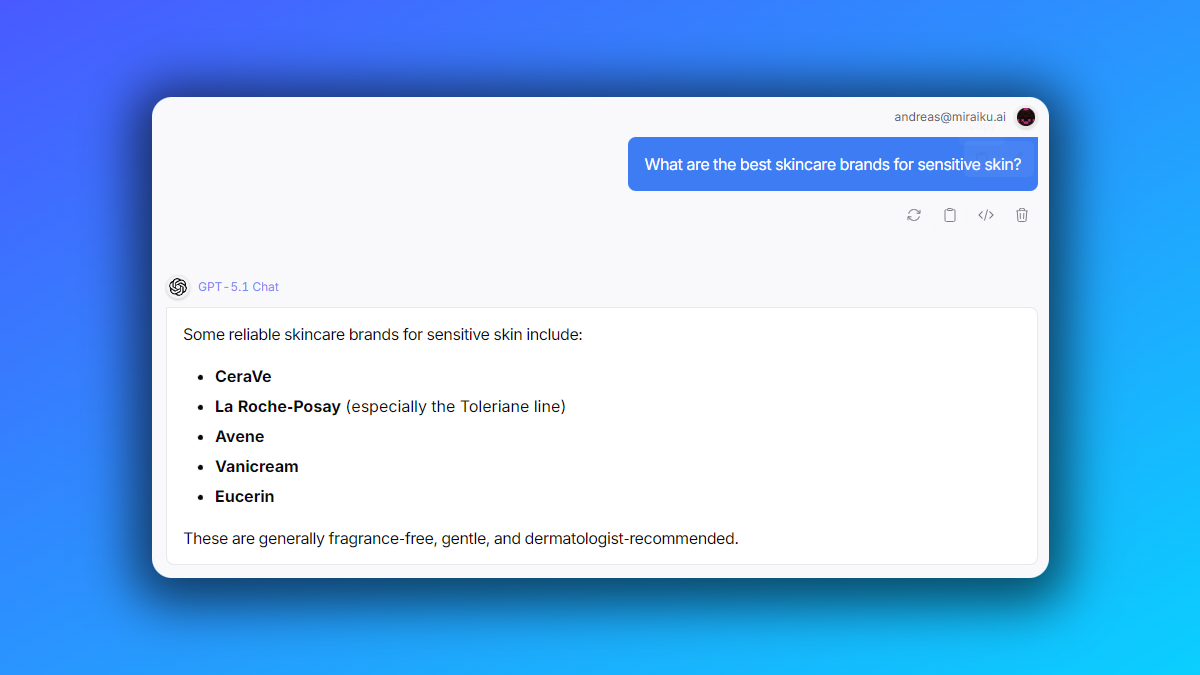
api prompt response
What the API delivers is not what users see. The answer is stripped of citations, references and context, which means it cannot be used for reliable visibility analysis.
APIs are not the platforms users interact with
When someone opens ChatGPT or Gemini and asks a question, they are interacting with a specific environment. This environment includes a UI, a browsing system, grounding rules, reasoning steps, safety layers, and a constantly evolving set of behaviours. The API, on the other hand, is a separate interface designed for developers. It often runs on different configurations, delivers different reasoning depth, uses different safety filters and sometimes even different versions of the model.
This means the answer coming from an API is, in many cases, not the answer users see inside the platform. The gap is not subtle. It affects the content, tone, structure, sources and even the recommendations the model produces.
API responses remove the entire layer of citations, grounding and source attribution
One of the biggest losses when collecting data via API is the source layer. Real platform responses increasingly include grounding URLs, citations, snippets extracted from trusted sources, thumbnails, browsing expansions and other elements that tell us why the model chose one brand over another.
This information is not decorative. It is the backbone of any GEO strategy. It reveals:
which domains shape the model’s answer,
what sources it relies on most,
how it justifies its recommendations,
which URLs repeatedly appear in grounding.
When a dataset is collected via API, all of this disappears. The model stops soucing URLs. The grounding vanishes. Citations change. The structure is reduced to plain text. The decision-making trace becomes invisible. Without this information, understanding visibility becomes guesswork.
Element Missing in API Data | Why It Matters |
|---|---|
Citations | You lose the evidence behind the answer and cannot see which sources shaped the model’s recommendation. |
Grounding URLs | Impossible to identify the domains influencing the model, limiting PR, content and outreach strategy. |
Snippets and Extracted Text | You cannot analyse what information the model considered relevant or trustworthy. |
Thumbnails and Visual Cues | You miss how the interface highlights sources and how users perceive credibility trough thumbnails and other rich snippets |
Browsing and Expanded Sources | You cannot see when the model actively searches or references live content. |
Most user interactions happen logged out, and APIs cannot represent this reality
Around 80 percent of generative interactions happen with the user logged out. This means that most generative journeys are not personalized. They reflect the model’s default behaviour, not the tailored version it produces for individual users.
API calls cannot replicate this. They operate in a persistent technical state, disconnected from the natural conditions of usage. A visibility tool built this way will never reflect what the majority of people actually see.
This matters because generative search is becoming a major influence channel. If we want to measure it, we must measure it in the conditions where it truly happens.
Market differences demand real geolocated data sampling
Generative platforms behave differently across markets. Grounding sources change depending on local media ecosystems. Some markets have trusted editorial brands that others do not. Product availability shifts. Legal and safety rules differ. Even the same prompt will often produce different citations in Germany, Spain, the US or Brazil.
A credible measurement framework needs to simulate users in each market, not a centralized API call that may or may not reflect local behaviour.
Collecting data from the real platform, inside each country, ensures that:
local grounding signals appear,
regional differences are captured,
language and cultural nuances are respected,
and the data reflects what real consumers see.
Stochastic models require representative samples
Generative models are stochastic. Two identical queries may not produce identical answers. This does not mean the model is unreliable. It is an inherent feature of how probability-driven systems behave.
But it does mean that:
one answer is not enough,
one API response is not meaningful,
one single dataset cannot represent the whole picture.
To get credible insights, you need repetition, sample size and temporal snapshots. You need to observe patterns, not moments. You need to analyse the distribution of outcomes, not a single instance.
When randomness is already part of the system, using an API adds a second layer of randomness that comes not from the model, but from the method of collection. This is where bias becomes structural.
If the model varies naturally and the sampling method distorts the result, the dataset becomes impossible to trust.
Measuring LLMs the Right Way
The shift toward generative search is reshaping how users learn, evaluate and decide. If brands want to understand that space, the starting point must be the integrity of the data. Metrics, dashboards and visualizations mean nothing if the foundation is flawed. Reliability begins with observing the platforms the way users do.
At Prominence AI, we built our measurement framework around that principle. We collect real platform data directly from the interfaces users rely on, not from API shortcuts. Our infrastructure captures answers exactly as they appear in each market, under real usage conditions, to build representative datasets grounded in true behaviour and accurate geolocation.