

As generative platforms continue to shape how users discover and evaluate brands, understanding visibility inside these models has become essential. Until now, most measurement frameworks for LLM visibility have relied mainly in Share of Answer, which reflects how often a brand appears as the primary recommendation.
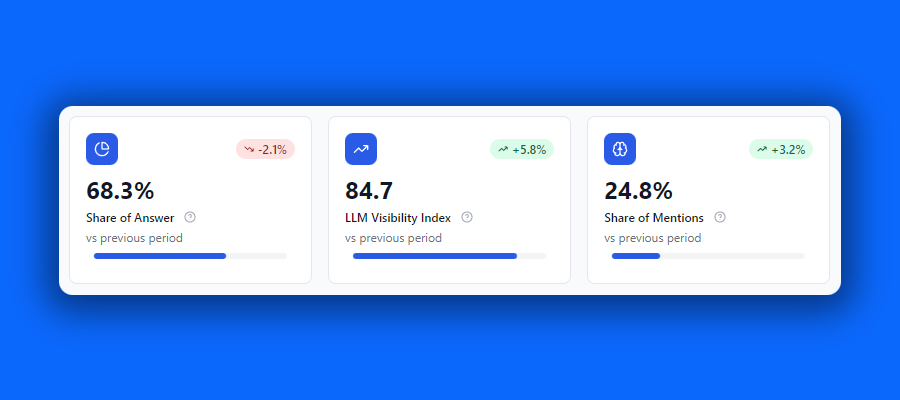
share of mentions
Today, we introduce a fourth metric that completes this foundation. One that reveals how much space a brand occupies in the broader set of citations that LLMs generate. One that helps brands understand not only whether they appear, but how much of the model’s overall attention they actually receive. This is Share of Mentions, and it is now available inside Prominence AI.
What Share of Mentions really measures
Share of Mentions answers a simple but powerful question: Out of all the brand mentions detected across the LLM’s answers, what percentage belongs to my brand?
This metric does not measure how often your brand appears per response. Instead, it reflects your proportional weight within the entire pool of entities the model cites.
A quick example makes this very clear:
If, across 100 prompts, the models mention brands a total of 600 times, and your brand accounts for 50 of those mentions, your Share of Mentions is: 50 / 600 = 8.3 percent
This percentage represents your brand’s presence within the full conversational landscape that the model generates. It is the closest equivalent in generative environments to the traditional “share of voice” metrics used in marketing.
Why this metric matters
LLMs do much more than pick a single winner in each answer. They reference alternative brands, provide examples, compare options and enrich explanations with secondary citations. Being part of that broader conversation matters.
Share of Mentions helps you understand:
The proportion of attention the model allocates to your brand.
Your brand’s weight within the competitive space.
How the model distributes visibility among all relevant entities.
Whether your presence is concentrated (few answers but strong mention density) or widespread.
For marketers, this metric provides a more nuanced read of brand presence. It shows not only whether you appear, but how much space you occupy when the model talks about the category.
The impact of prompt types and industry verticals
An important nuance is that the total number of entities cited can vary significantly depending on:
the nature of the prompt (exploratory, comparative, instructional),
the vertical (beauty, retail, tech, luxury),
and the model’s behaviour at a given point in time.
For instance, exploratory prompts such as “What are the best skincare brands for sensitive skin?” typically produce more mentions than functional prompts like “How do I apply sunscreen correctly?”.
We have also observed a recent pattern in ChatGPT. The average number of entities mentioned per prompt has slightly declined, suggesting a shift toward more concise or more curated responses. This reinforces the need for metrics that adapt to real model behaviour rather than relying solely on presence-based indicators.
How Share of Mentions complements the core GEO metrics
The introduction of Share of Mentions is not meant to replace anything. It is meant to complete the measurement stack.
Metric | What It Measures | What It Tells You | How It Differs |
|---|---|---|---|
Share of Answer (SOA) | The percentage of answers where your brand appears at least once. | How present your brand is across all responses. A direct indicator of reach inside LLM outputs. | Focuses on presence. Measures whether you appear in the answer, not how the model distributes mentions. |
Share of Mentions (SOM) | Out of the total number of brand mentions across all answers, what percentage belongs to your brand. | Your share of citations inside the model’s full set of responses. | Focuses on distribution of all mentions. Measures your brand’s weight in the entire pool of entities cited by the model. |
Average Position (Avg. Pos) | Your prominence inside each answer, weighted by position. Higher placement yields higher scoring. | How strongly your brand stands out inside responses. Similar to an average ranking, but adapted to generative outputs. | Focuses on strength of placement. Measures how prominently you appear, not just if or how many times. |
Citations | The number of times your website is referenced as a source inside an LLM-generated response. | Whether the model is grounding its answers in content you control, and how frequently that happens across prompts. | Unlike SOA or SOM, Citations is asset-level, not brand-level. It tells you where your influence is coming from, not just that you appear. |
TLDR;
SOA = Do we appear?
SOM = How much of the total conversation belongs to us?
Avg. Pos. = How strongly and prominently do we appear?
Citations = Are our own assets the ones being cited?
This matters because in many categories, users are influenced not only by the single answer but by the supporting context. Being mentioned consistently still shapes perception.
A metric shaped by your competitive configuration
Share of Mentions is highly sensitive to how each user configures their project in Prominence AI. If you track more competitors, the denominator increases. If you track fewer, it decreases.
This is not a limitation. It is a reflection of the reality of competitive ecosystems. Your Share of Mentions always describes your position within the universe you have defined. For teams, this means a more flexible and meaningful comparison, adapted to their actual market structure.
A brief note on interpretation. Although Share of Mentions is intuitive, a few principles help interpret it:
A high score means your brand is frequently cited, even when not leading.
A low score does not imply irrelevance if Share of Answer is strong.
Spikes or drops often signal shifts in category discussions or model updates.
Comparing this metric across models reveals how differently each platform distributes attention.
Share of Mentions completes the visibility framework that Prominence AI has been building. It helps brands see beyond winners. It reveals how models distribute attention. It offers a new layer of clarity in an environment where understanding presence is becoming essential.