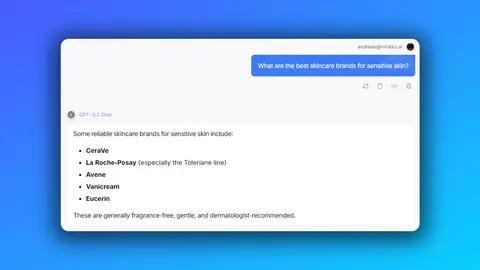

Ask ChatGPT for the best hybrid family SUV, the best moisturiser for dry skin or the best running shoe for flat feet, and you don’t get ten blue links. You get a short list of products, ranked, compared and explained in a few lines. Some of them are yours. Most of them, usually, are not.
That list is a shelf. Monitoring your brand tells you whether you are on it. It doesn’t tell you which of your products made it.
The answer is the new shelf
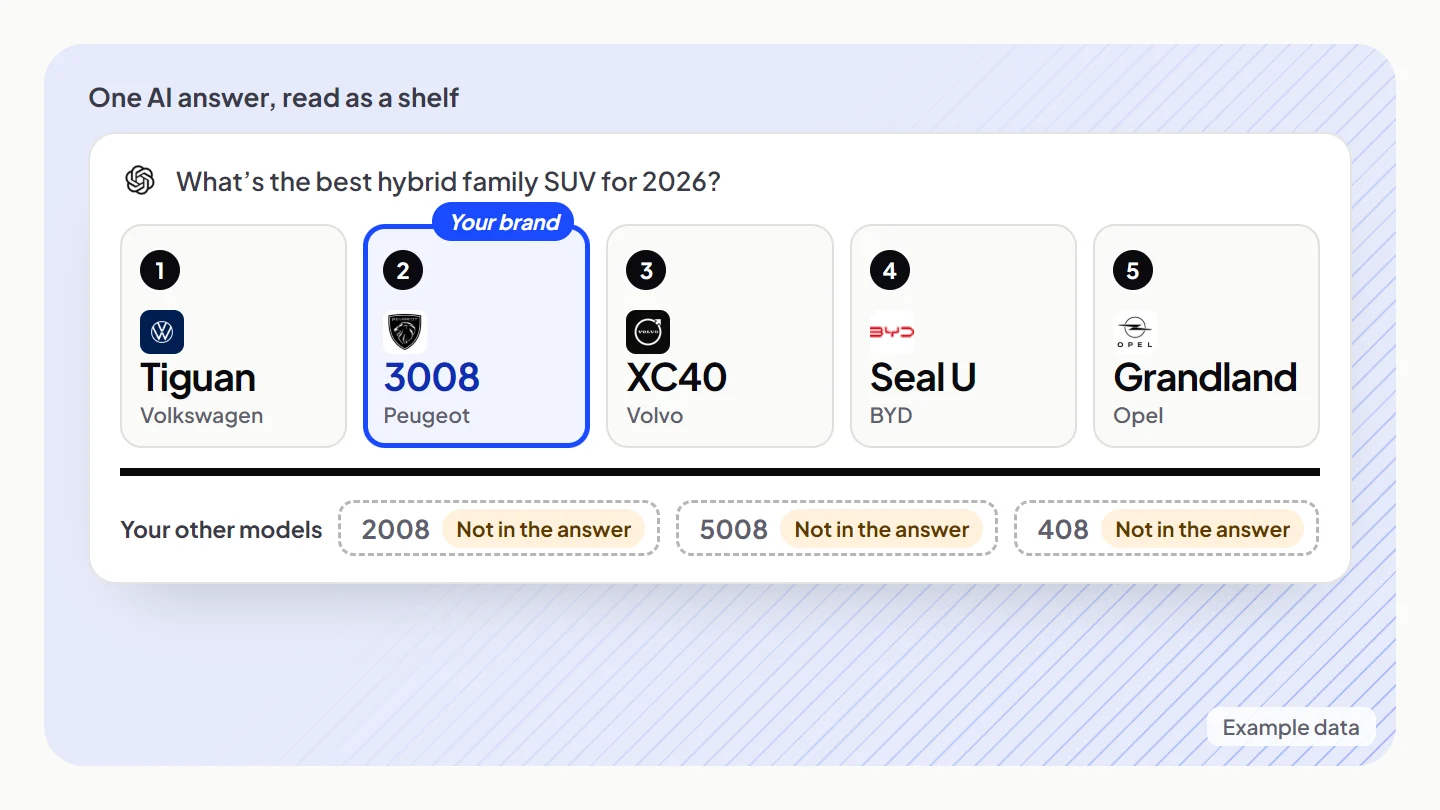
A generative answer behaves like a shelf in a store. Space is limited, the order matters, and every product sits next to its competitors. What earns the place is a product, not a logo: the answer recommends the 3008 or the Tiguan, not “Peugeot” or “Volkswagen”.
There is one big difference with a physical shelf. A brand is not on one shelf, it is on dozens at the same time. The same carmaker appears in answers about family SUVs, electric cars under a budget and first cars, with a different model each time, against a different set of rivals. A beauty brand shows up in fragrance, skincare and gift answers. Every intent is its own shelf, and the brand can win one and be absent from the next.
Why brand-level visibility is not enough
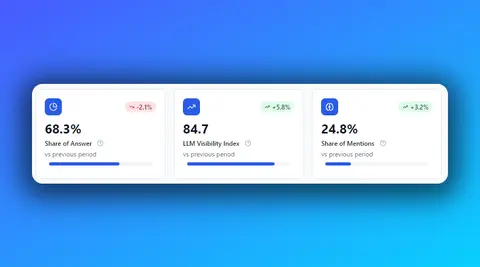
Brand metrics are still the right top line. Share of Answer, Share of Mentions and average position tell you whether AI recommends you and how that compares with your competitors. We built Prominence around them and they are not going anywhere.
But a brand metric is an average of a portfolio, and averages hide what matters for brands with many products:
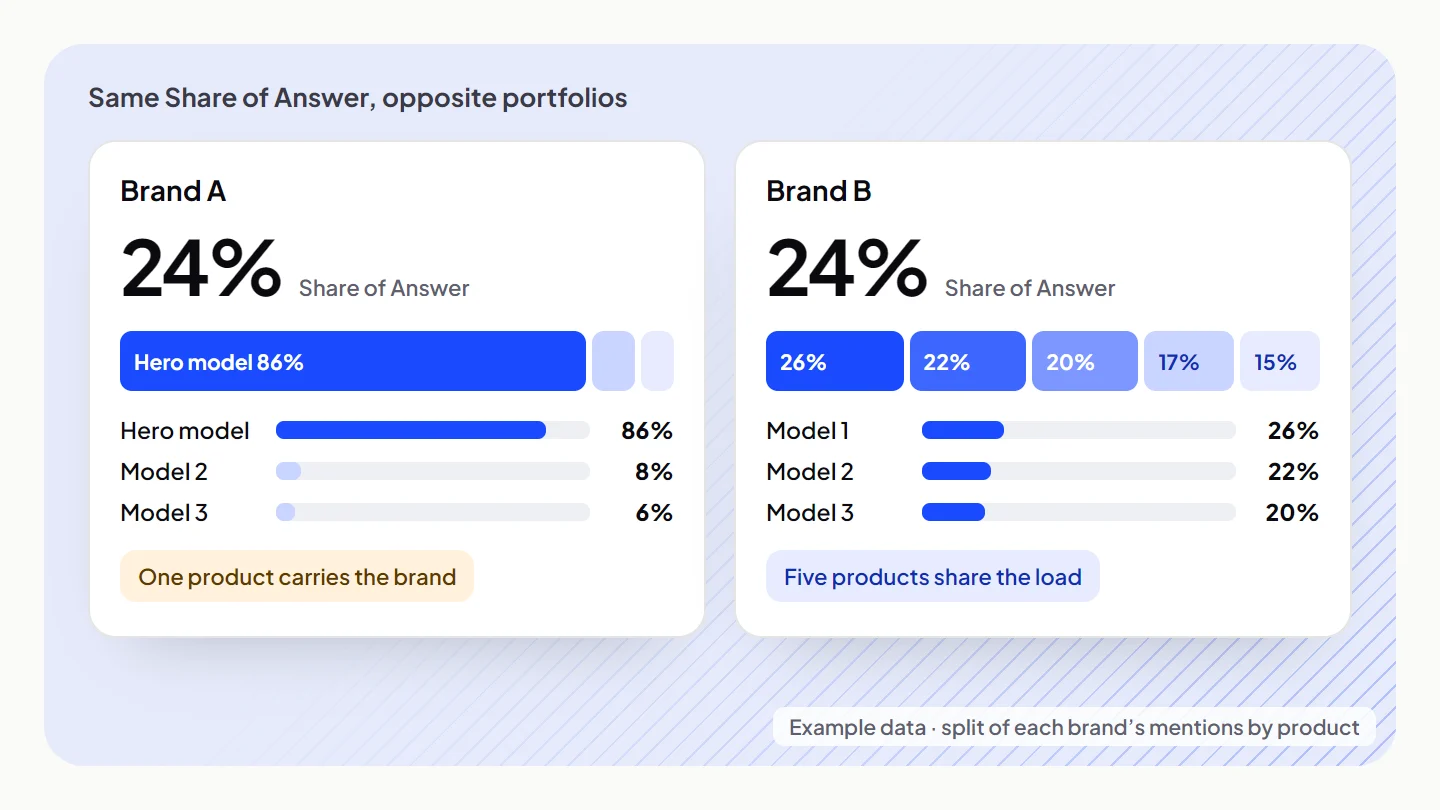
- One product can carry the brand. A brand can hold a steady Share of Answer while a single hero product does all the work and the rest of the range never appears.
- The same score can mean opposite things. Two brands with the same share can have opposite portfolios: one with a product in almost every answer, the other with five products sharing smaller pieces.
- Decisions are made per product. Which model to push in a campaign, which launch needs content, which product page a retailer should fix. None of those decisions can be taken from a brand average.
For categories with broad portfolios, like automotive, beauty or retail, what you need is traceability at the level of the SKU, the model or the service: which of your products AI recommends, against which of your competitors’ products, for which needs.
Introducing Prominence AI Products
Products takes the answers your monitor already collects and reads them product by product, for your brand and for every competitor you track. Same prompts, same engines, same filters. One level deeper.
It answers four questions that brand metrics can’t:
- How much of the shelf does each product hold? Share of Answer, Share of Mentions and average position for every product, and how much of your catalog AI recommends at all.
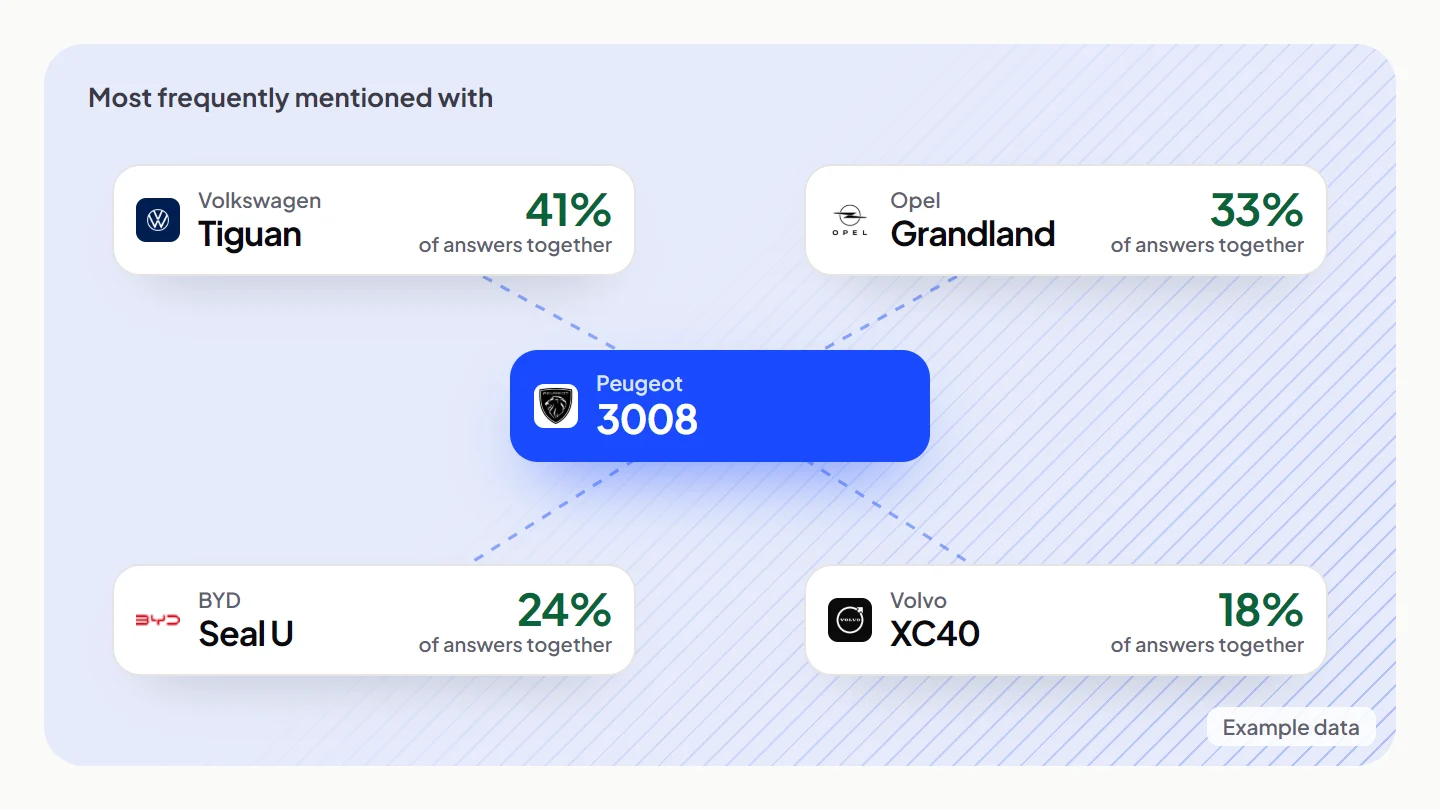
- Who are you mentioned with? The competitor products that appear in the same answers as yours.
- How does the category split? Each brand’s share of all product mentions, and which products hold it up.
- Where does each product win, and how is it moving? By intent segment, by engine and week by week against the category average, with the biggest gains and drops of the period.
You can see every section, metric and filter on the Products page.
Co-mentions: the comparison you didn’t choose
Of everything Products measures, co-mentions are the signal we find most revealing. When an AI answer puts your product next to another one, it is defining your competitive set, whether you agree with it or not.
Sometimes it is the rival you already plan against. Sometimes it is not: a product from another price range, a model you thought was in a different segment, or a brand you don’t even track. Knowing which products AI places next to yours tells you which comparisons your content has to win, and which sources are building that comparison.
How it works
- Built on your monitor. Products uses the prompts and engines your monitor already tracks. There is no separate project to maintain. Changes are compared with the previous period of the same length, and you can filter by period, engine and segment, as in the rest of Prominence.
- A shelf, not a sample. Track up to 20 products of your brand and up to 20 for each competitor. With five competitors, that is up to 120 products measured on the same shelf.
- Set up in under 5 minutes. The guided autosetup builds your product library for you, from your brand’s and your competitors’ websites and from the answers already collected. You can also upload a .csv, .xlsx or .txt file, or paste a list. You review everything before anything is tracked, and new competitor products keep being detected automatically.
- Also in your agent and your stack. Product data is available through the Prominence MCP and through a dedicated API endpoint, so you can ask about your portfolio from Claude or ChatGPT, or bring it into your own dashboards.
This is the first version. We will keep adding detail to the product layer over the coming months.
Three questions to ask about your portfolio
If you track a portfolio, these are the three questions we would start with:
- Which of your products never appear? Catalog coverage tells you how many of your products get at least one recommendation. The ones at zero are usually the cheapest wins.
- Which competitor product shows up next to your hero product? That is the comparison buyers are reading. Make sure your content wins it.
- Where does your best product disappear? The segment matrix shows the intents where a product that leads elsewhere drops to zero.
Products is live and included in every Prominence AI plan. See how it works, or book a demo and we will walk you through your own portfolio.